French drain contractor matching — Atlanta metro
French Drain Installation in Atlanta, GA
A French drain collects water in the ground and carries it away. Done properly it is a gravel trench, filter fabric, perforated pipe and continuous fall to a real outlet.
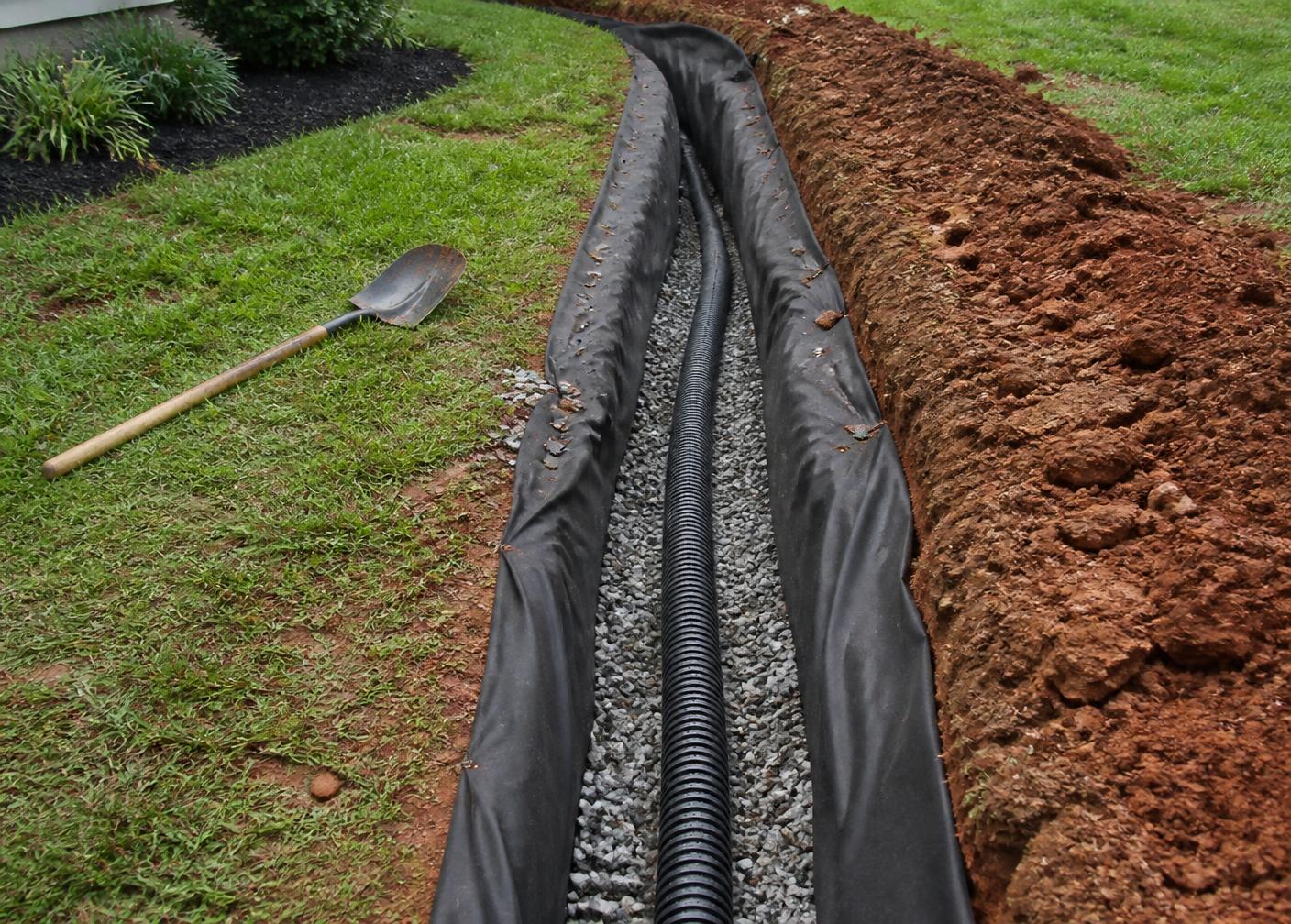
A French drain is a subsurface collection system: a trench excavated to fall, lined with filter fabric, bedded with washed stone, fitted with perforated pipe and backfilled with more stone. Water in the surrounding soil moves into the stone, enters the pipe and travels downhill to a discharge point.
It is the right tool for saturated ground — not for every wet yard. When the problem is a distinct puddle on the surface, a catch basin usually solves it faster and for less money. When soil stays wet across a wide area, or water moves through the ground toward the house, a French drain is usually the better answer.
Problems a French drain is built for
- Broad areas of the lawn that stay saturated well after the rain ends
- Water seeping toward a crawl space, basement wall or slab edge
- Water moving downhill through the soil from an uphill lot or slope
- A soggy strip along the bottom of a hill or retaining wall
- Turf that never fully dries out between storms
When a French drain is appropriate
- The wet area is broad and diffuse rather than a single defined puddle
- Subsurface water is the main issue, not just surface sheet flow
- There is enough elevation change to build continuous fall to an outlet
- The wet zone sits uphill of the structure you want to protect
How French drain installation typically works
1. Layout and fall
The trench line is set from the wet zone to the lowest usable outlet. Fall is verified along the entire run; a flat section will collect sediment and stop working.
2. Excavation
The trench is cut to depth and width for the design — deeper for interception near structures, shallower for turf areas.
3. Fabric and stone
Non-woven filter fabric lines the trench to keep clay fines out of the stone. Washed, angular stone forms the bed so the void space stays open.
4. Pipe, backfill, discharge
Perforated pipe is laid to grade, covered with stone, wrapped with the fabric, and connected to solid pipe where water needs to be conveyed. The line ends at daylight or an emitter away from the house.
French drains in Georgia clay
Clay is the reason so many Atlanta French drains underperform. Fine clay particles migrate into unwashed or unwrapped stone and clog the void space, so a trench that drained well the first season can slow dramatically within a few years.
Filter fabric selection, washed stone and adequate trench volume matter more here than in sandy regions. So does the discharge: because clay will not absorb the collected water, dry wells and short runs that simply end in the yard tend to disappoint. The line needs somewhere to go.
Typical considerations
- Linear footage and trench depth drive most of the cost
- Washed stone versus job-site fill materially affects service life
- Rock, roots or existing hardscape can complicate excavation
- Cleanouts make future maintenance possible
- Discharge location must not create a problem on adjacent property
- Turf and bed restoration along the trench line
Get a free estimate for french drain installation
Submit your property details and project description through the form. No phone calls required to start.
Questions
French Drain Installation — Frequently Asked Questions
How deep should a French drain be in Atlanta?
It depends on purpose. Turf-area drains are often relatively shallow, while an interceptor protecting a basement or crawl space is set deeper so it catches water before it reaches the wall. Depth is always limited by the elevation available at the outlet.
Does a French drain need an outlet, or can it end in the ground?
In heavy clay it needs a real outlet. Terminating a line into clay simply stores water. Daylight discharge, a pop-up emitter or another approved outlet at a lower elevation is what makes the system work.
How long does a French drain last?
Service life depends mostly on materials and installation quality — washed stone, appropriate filter fabric, correct fall and cleanouts. Systems built with fines-laden backfill or inadequate fabric can clog quickly in clay soil.
Can a French drain and catch basins be combined?
Frequently, yes. A common Atlanta configuration uses catch basins to capture surface ponding, a perforated section through the saturated zone, and solid pipe tying everything to one discharge point.