Channel & trench drains — Atlanta metro
Channel & Trench Drain Installation in Atlanta, GA
A channel drain is a long, narrow inlet set into a hard surface. It intercepts sheet flow across its full length rather than at a single point.
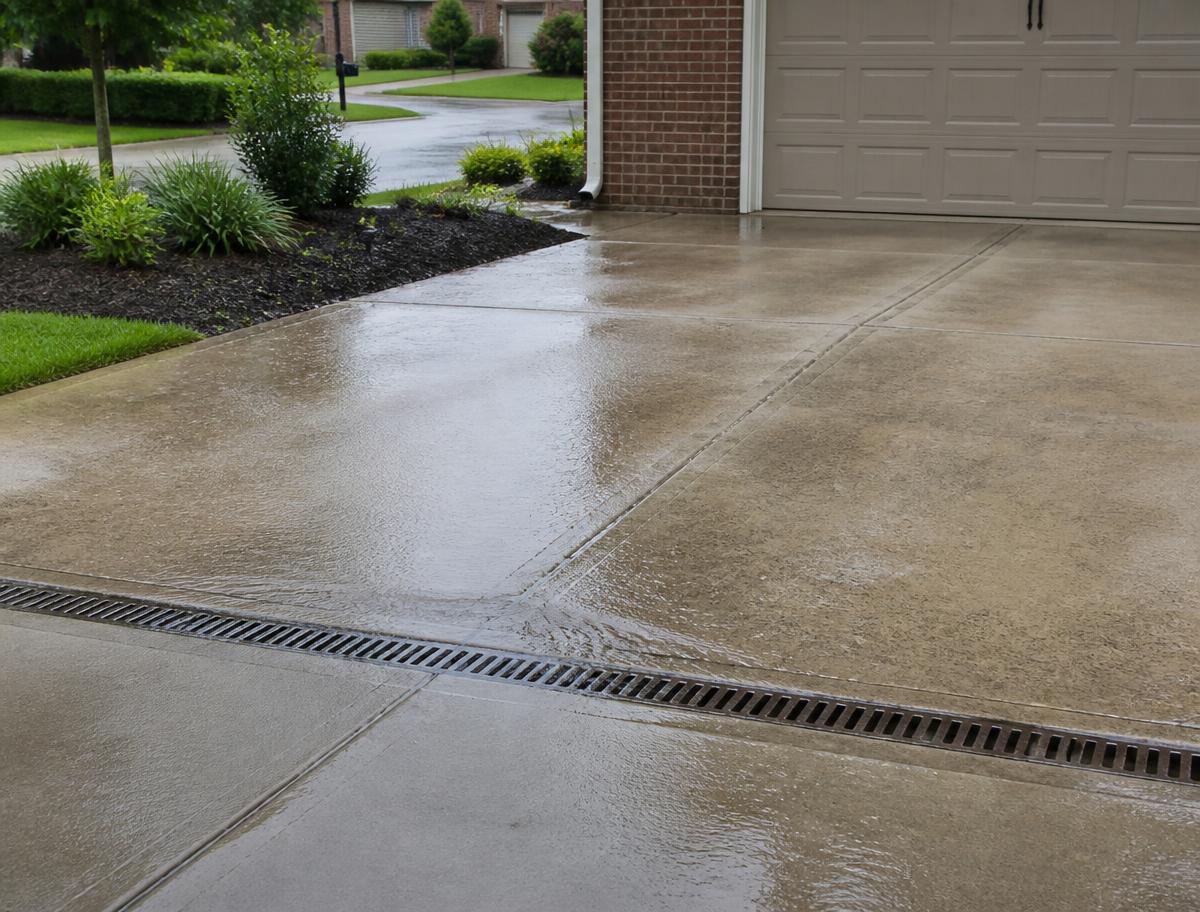
Channel drains — also called trench drains or linear drains — are used where water runs across a paved surface instead of collecting in a puddle. They are set flush into concrete or pavers so runoff drops into the channel and is piped away.
The classic Atlanta application is a sloped driveway that sends water straight at a garage. A channel drain across the apron catches that flow before it reaches the door. The same approach is used at patios, walkways, pool decks and garage thresholds.
Where a channel drain helps
- Water running down a driveway toward the garage door
- Runoff crossing a walkway or patio and continuing toward the house
- Water sheeting off a slab into an adjacent low lawn area
- Pooling at the base of a sloped hard surface
- Water entering a garage during heavy storms
When a channel drain is appropriate
- Water arrives as a wide sheet rather than collecting in one spot
- The surface is paved and a single basin cannot capture the flow width
- You need to protect a threshold — a garage, doorway or basement entry
- Existing pavement can be saw-cut or the surface is being replaced anyway
How channel drain installation typically works
1. Establish the intercept line
The channel is positioned across the flow path, upstream of whatever needs protection, at a location where fall to an outlet is available.
2. Cut and excavate
Existing concrete is saw-cut and removed along the line, or the channel is set before new pavement is poured.
3. Set the channel to grade
Sections are aligned and set slightly below the finished surface so water enters, then encased in concrete to hold alignment under vehicle load.
4. Pipe and discharge
The channel outlet ties into solid pipe running to daylight or another approved discharge point away from the structure.
Driveways and slopes in metro Atlanta
Many homes in the region sit on rolling terrain with driveways cut down to a garage below street level. Those driveways function as a chute during heavy rain and concentrate significant volume at the lowest point.
Grate selection matters here because most residential channel drains carry vehicle traffic. Load rating, frame type and how well the channel is encased in concrete determine whether the installation survives years of cars crossing it.
Typical considerations
- Channel length across the flow path
- Load rating for vehicle traffic versus pedestrian areas
- Concrete cutting, removal, disposal and patch-back finish
- Grate material and finish — polymer, galvanized steel, stainless or ductile iron
- Outlet routing and available fall beyond the channel
- Matching the patch to existing pavement appearance as closely as practical
Get a free estimate for channel drains
Submit your property details and project description through the form. No phone calls required to start.
Questions
Channel Drains — Frequently Asked Questions
Can a channel drain be added to an existing concrete driveway?
Yes. The concrete is saw-cut along the drain line, the channel is set and encased, and the surface is patched. A visible patch line is normal on retrofit installations.
Channel drain or catch basin for a driveway?
If water spreads across the driveway width, a channel drain captures it. If it converges into one low spot, a basin can be enough. Some driveways use a channel at the apron and a basin at the low edge.
Do channel drains clog?
They collect leaves, pine straw and grit like any inlet. Removable grates and a catch basin with a sump on the outlet side make routine cleaning straightforward.
How long does a driveway channel drain installation take?
Many single-run driveway installations are completed in one to two working days, plus concrete cure time before vehicles can cross the patch.