Driveway & garage water — Atlanta metro
Driveway Drainage Solutions in Atlanta, GA
Driveways are large impervious surfaces pointed at your house. When one floods, the fix is to intercept the flow before it reaches the garage.
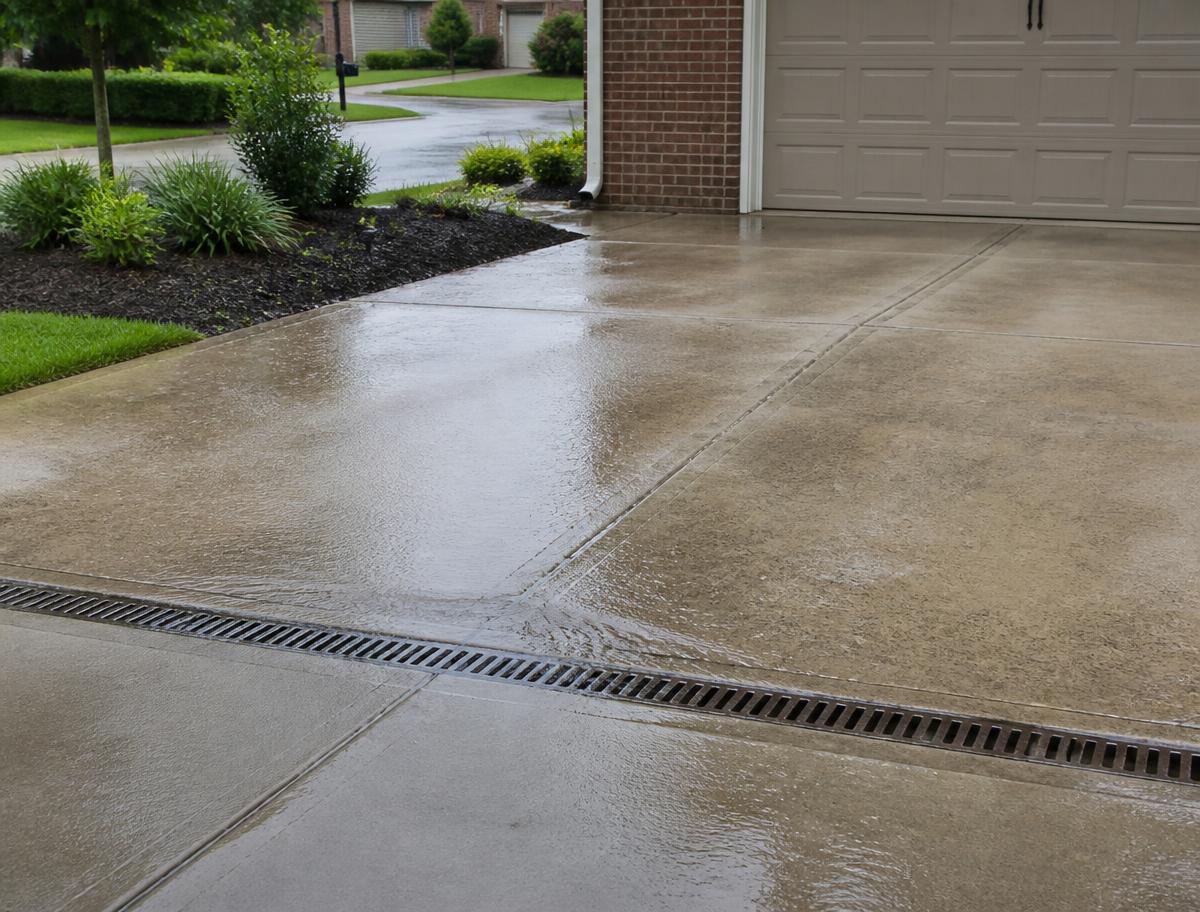
Driveway drainage addresses runoff generated by, or arriving at, a paved drive. Because the surface is impervious, essentially all the rain that lands on it becomes runoff, and it accelerates as the slope steepens.
The right solution depends on how water behaves. A drive sloping toward the garage usually needs a channel drain across the apron. A drive with a low edge that ponds often needs a basin and pipe. A drive that sheds onto the lawn and washes it out may need capture, grading, or both.
Common driveway water problems
- Water reaching or entering the garage during heavy rain
- Standing water on the driveway surface after the storm ends
- Washouts and gullies along the driveway edge
- Silt and gravel deposited across the drive after rain
- Runoff from the street or an uphill neighbor entering the driveway
- Ice patches at the low end during winter cold snaps
When driveway drainage work is appropriate
- Runoff volume is high enough to threaten the garage or a lower-level entry
- The driveway slopes toward the structure rather than to the street
- Water pools on the pavement instead of shedding
- Driveway runoff is creating a wet area or erosion in the yard
How driveway drainage typically works
1. Trace the flow path
Where water enters the driveway, where it accelerates, and where it stops are identified before choosing a solution.
2. Intercept at the right line
A channel drain across the apron, a basin at the low edge, or a curbed edge — chosen to match how water actually arrives.
3. Convey away
Captured water is piped in solid pipe to a discharge point at a lower elevation, away from the foundation and off adjacent property.
4. Protect the surroundings
Edges are stabilized and adjacent turf or beds are graded so the new discharge does not create the next erosion problem.
Why Atlanta driveways flood
Homes built into hillsides frequently have driveways that drop from the street to a garage below, so gravity delivers everything the pavement collects straight to the door. Long shared drives on wooded lots add leaf litter that blocks whatever inlets exist.
Clay soils along the driveway edge do not absorb overflow quickly, so water that leaves the pavement tends to travel along the edge and cut channels rather than soak in.
Typical considerations
- Driveway slope, width and total contributing area
- Whether concrete cutting is required for a retrofit
- Load rating for vehicles crossing any grate
- Where the collected water can legally and practically be discharged
- Street runoff arriving at the top of the drive
- Appearance of concrete patch-back at the cut line
Get a free estimate for driveway drainage
Submit your property details and project description through the form. No phone calls required to start.
Questions
Driveway Drainage — Frequently Asked Questions
How do I stop water from running into my garage?
The usual approach is to intercept the flow before the door with a channel drain set across the apron, piped to a lower discharge point. Grading adjustments at the drive edge often support it.
Can driveway drainage be added without replacing the driveway?
Yes. Retrofit installations saw-cut a narrow line for the drain, set and encase it, then patch the concrete. Full replacement is only needed when the pavement itself is failing.
Where does driveway water go after it is collected?
To a lower point on the property by gravity — daylight discharge, a pop-up emitter or an approved outlet. It should not be routed onto a neighboring lot.
What if the street sends water down my driveway?
That is common on sloped Atlanta streets. Intercepting near the top of the drive, sometimes combined with a raised edge, keeps street runoff from running the full length of the pavement.